









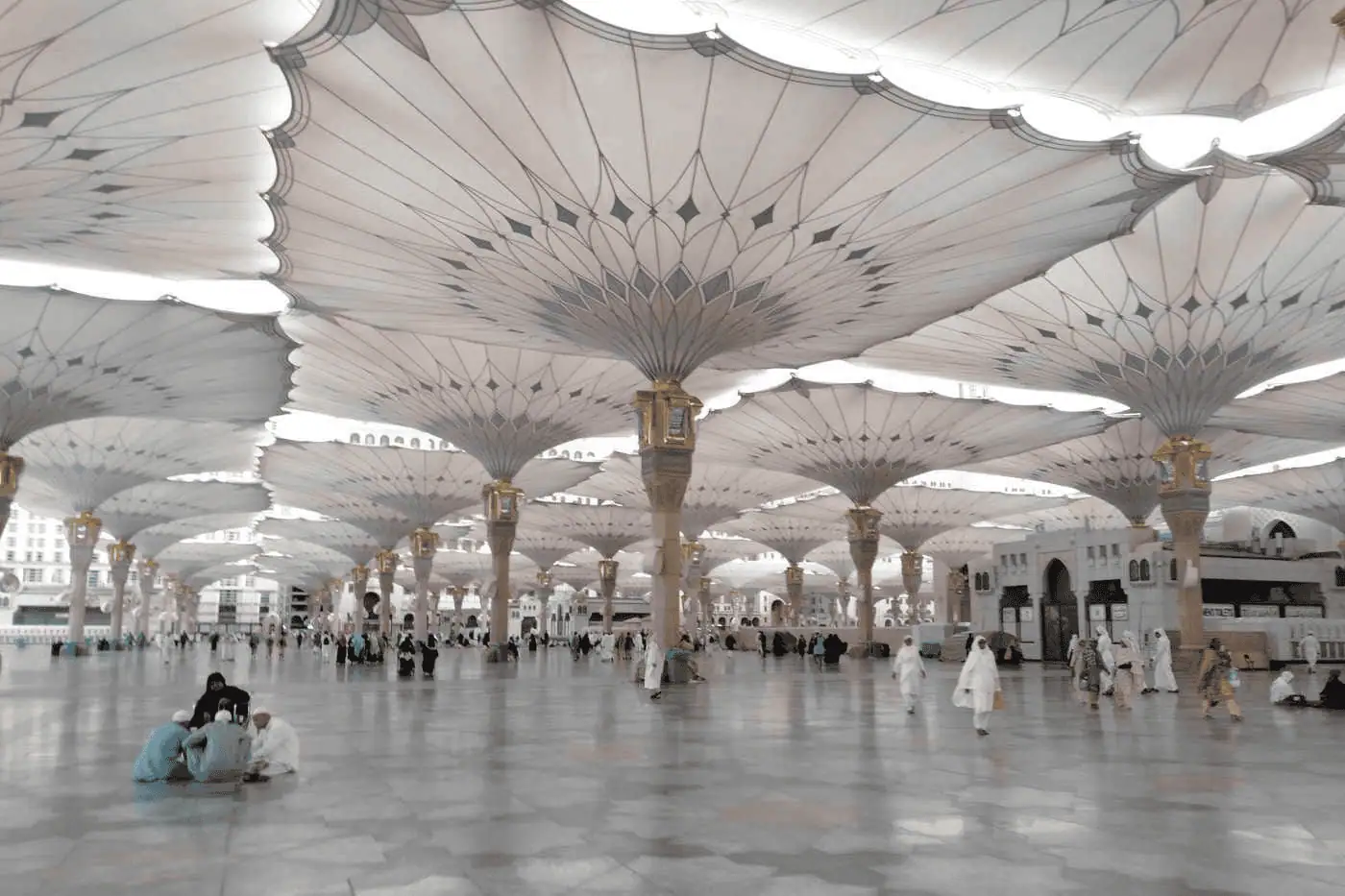
Every morning in Medina, the courtyards around the Prophet’s Mosque shift into shade. Giant umbrellas rise from the ground and open above the marble floors, covering the space where thousands gather to pray, rest, or just sit and take in the moment. You’ve probably seen photos. Neatly lined canopies, fans gently cooling the air, and people moving through with ease.
But behind this quiet elegance is a story worth knowing. One of vision, faith, and world-class engineering. The history of the Prophet’s Mosque umbrellas in Medina begins long before they became a symbol of comfort for millions. And once you know how they came to be, you’ll never see them the same way again.
Let’s walk through it together.
Where It All Started
The very first set of retractable umbrellas was introduced back in 1992. Only 12 at the time. Smaller in size but big in purpose. They covered two inner courtyards, opened hydraulically, and gave visitors a much-needed break from the Medina sun.
These early umbrellas set the foundation. They stood the test of time, running for years without needing replacement. But the crowds kept growing, and so did the heat.
That’s when the project took a giant step forward.
The Vision Grows Under King Abdullah
King Abdullah bin Abdulaziz wanted to create something that would truly serve every pilgrim walking into the courtyard. Not just a functional upgrade, but a graceful one. A place where tradition could meet technology without losing its soul.
Between 2008 and 2010, the expansion began. First came 182 umbrellas. Then 68 more followed in the eastern courtyard. The result was a total of 250 smart, retractable umbrellas, each one designed to open, close, and shelter with precision.
The Size and Strength Behind the Shade
Each umbrella covers an area of about 625 square meters. Together, they stretch across a massive 143,000 square meters of shaded space. That’s enough room to protect more than 200,000 worshippers at once. And when closed, each umbrella stands 21 meters tall, roughly the height of a seven-story building.
They’re not light, either. Each one weighs around 40 tons. But thanks to a brilliant folding system made with six moving arms, they open smoothly in under three minutes. It’s all programmed. No stress. No collisions. Just a calm, coordinated unfurling.
Why the Umbrellas Stay Cool Even in the Heat
What makes these umbrellas so effective is the fabric. It’s called PTFE—tough, durable, and heat-resistant. The material was specially made to reflect sunlight, block UV rays, and withstand Medina’s weather all year long.
They’re sand-colored, not white, to prevent glare. They’re designed to breathe, so they don’t trap heat. And when combined with built-in mist fans, 436 of them, in fact, they create a cool, breezy environment even during the hottest hours.
Each fan can spray up to 200 liters of purified water per hour. It’s soft, it’s clean, and it helps lower the temperature by up to 14 degrees Celsius on summer afternoons.
Who Built Them and How It Came Together
The umbrellas at the Prophet’s Mosque didn’t come from one country or one company. They came from a network of minds working together.
The design was led by Dr Mahmoud Bodo Rasch of SL Rasch, a German architectural firm known for lightweight structures. The fabric came from SEFAR in Switzerland. The folding arms were made using carbon fiber composites. Japan’s Taiyo Kogyo brought its experience in membrane construction. And Saudi teams handled construction and integration on site.
It was an effort that crossed borders and brought together talent from all over the world, each team doing its part to honor the sanctity of this place.
Smart Systems, Quiet Motions, and Perfect Timing
The umbrellas know when to open and when to stay closed. It depends on the time of day and the weather.
In the summer, they open after Fajr and again after Maghrib. They stay open through the day, shielding worshippers during prayers and rest. In the winter, they’re closed during daylight to let the warmth in and opened at night to retain it.
Every movement is smooth and quiet. The arms fold like petals. You can feel the precision, but it never feels mechanical. It feels natural, as if the shade was always meant to be there.
Their Story Fits into a Bigger One
Long before the umbrellas, King Fahd’s expansion of the mosque introduced 27 sliding domes. They move too, just like the umbrellas, with motors that respond to the weather. These domes weigh 80 tons and are made of composite materials with tilework that matches the mosque’s style. Inside, you’ll find hand-carved cedar from Morocco.
The domes were a first glimpse of what technology could do for sacred spaces. The umbrellas built on that dream and took it even further.
A Ripple Effect Across the World
After the success of Medina, similar smart umbrellas were approved for Makkah. Some are even bigger, with spans of over 50 meters. The idea is spreading, showing how faith and innovation can meet without losing reverence.
Architects and engineers from other countries now look to this model. They study how comfort, sustainability, and spirituality can come together. The Medina convertible umbrellas shading project has become a global reference for climate-sensitive design.
It Changed How People Experience Pilgrimage
When you stand under one of those umbrellas, it’s easy to focus on what matters. Your thoughts, your prayers, and your connection.
You don’t have to fight the heat or search for space. You don’t need to rush indoors. Everything around you is calm, cool, and inviting. Someone thought about you. About your comfort. About your experience.
That’s what these umbrellas offer.
A Structure with Heart
The history of the Prophet’s Mosque umbrellas in Medina is built on intention and care. From the fabric chosen to the misting fans placed with precision, every detail was designed to serve the people who gather here. It reflects deep respect for the space and those who visit it.
This kind of design leaves a mark. It becomes part of your experience. A part of your worship. And when you understand how it came to life, standing beneath the shade feels even more meaningful.
FAQs
When were the Prophet’s Mosque umbrellas first installed in Medina?
The first umbrellas were installed in 1992 to provide shade in two inner courtyards. The current system of 250 umbrellas was completed by 2010.
How do the umbrellas at Masjid an-Nabawi work?
Each umbrella opens and closes automatically based on weather and prayer times. The system includes hydraulic arms, heat-resistant fabric, and built-in misting fans.
What are the Prophet’s Mosque umbrellas made of?
The canopy uses PTFE fabric that blocks UV rays and withstands extreme heat. The arms are made from lightweight, strong carbon fiber composites.
How much area do the Medina mosque umbrellas cover?
Each umbrella covers 625 square meters. Together, they shade up to 143,000 square meters and accommodate over 200,000 worshippers at once.
Why were the umbrellas added to the Prophet’s Mosque?
They were built to protect pilgrims from the heat and improve comfort during prayer and rest. The design respects both spiritual and environmental needs.
Follow us on Instagram for daily travel inspiration and untold stories from the Kingdom. Want more? Explore more experiences and stories in our Religious and Spiritual category.
This article is brought to you by Soul of Saudi (a Saudi travel blog dedicated to uncovering the beauty, heart, and soul of the Kingdom).