









High in the mountains of northwest Saudi Arabia lies a story carried through stone. Near Tabuk, archaeologists uncovered the oldest human settlement in the Arabian Peninsula, a site that reaches back eleven thousand years. The Ministry of Culture announced the discovery as part of its ongoing work to reveal Arabia’s deep past. What emerged is a picture of early communities building, gathering, and shaping life in ways that place Tabuk at the heart of human history.
A Discovery at Masyoun
The settlement was found at the Masyoun site, sitting on the eastern slopes of the Jabal al-Lawz mountain range. This is no ordinary location. At 1,424 meters above sea level, the highland environment offered fresh water, vegetation, and good hunting grounds. It was the perfect setting for early communities to build permanent homes. Dating to the Pre-Pottery Neolithic period, between 10,300 and 11,000 years ago, the site is now recognized as the earliest architectural evidence of stable human life in the region.
When you stand here, you are looking at the oldest human settlement Tabuk has ever revealed, a place where the story of architecture and community first began in Arabia.
How the Excavation Unfolded
The Masyoun site was first noted in Saudi records back in 1978. But it wasn’t until December 2022 that archaeologists began intensive excavations. Over four seasons, ending in May 2024, they pieced together the scale of this ancient community. The work was a collaboration between Saudi Arabia’s Heritage Commission, Kanazawa University of Japan, and the NEOM development company.
Archaeologists studied soil layers, cataloged stone tools, and analyzed organic remains for radiocarbon dating. They also documented nearby rock art and inscriptions, giving us a fuller picture of how people lived, worked, and expressed themselves here.
What the Settlement Looked Like
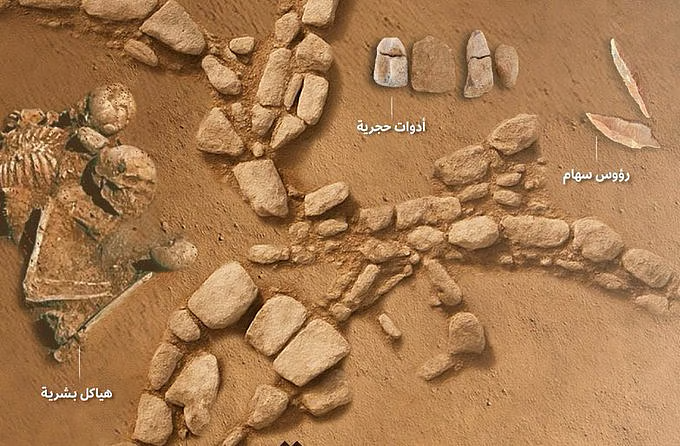
The discoveries at Masyoun paint a vivid picture of prehistoric architecture in Saudi Arabia. The settlement contained semi-circular stone-built structures made of granite, residential units arranged with thought and care, storage spaces for grain, and hearths where families cooked and gathered. Internal passageways connected different areas, suggesting a sense of planning and community life.
This was not a temporary camp. It was a carefully laid-out village, showing the earliest signs of food surplus management and shared living in the Arabian Peninsula.
Tools, Ornaments, and Everyday Life
Among the finds were arrowheads, knives, scrapers, and grinding stones. These tools tell us the people of Masyoun hunted, processed food, and cultivated early grains. More remarkable still were the ornaments—amazonite beads, quartz decorations, and seashells brought from distant coasts. These items prove there were exchange networks reaching far beyond Tabuk, linking this community with other regions of the Fertile Crescent.
Some stones carried geometric patterns, evidence of symbolic art and cultural identity. Life here wasn’t only about survival but also about meaning, beauty, and expression.
Clues About Lifestyle and Beliefs
Excavations uncovered human skeletal remains, offering insight into burial practices, as well as animal bones that point to diet and hunting strategies. There was also evidence of early beekeeping and grain cultivation. Together, these finds suggest that the people of Masyoun lived a hybrid lifestyle, still hunting and gathering, but already experimenting with agriculture and animal management.
Rock art and inscriptions found nearby add another layer to their story. These carvings show that symbolic communication and cultural expression had already taken root in Arabia’s earliest settled communities.
Rewriting the Origins of Arabian Civilization
The oldest human settlement in Tabuk is not just about stones and bones. It is about rewriting history. Dr. Ajab Al-Otaibi of the Heritage Commission called it “among the oldest settlements in the world” and highlighted how it proves the Arabian Peninsula was central to the rise of human civilization.
Far from being isolated, this land was a crossroads that connected Africa, Mesopotamia, the Levant, and Anatolia. The evidence from Masyoun places Arabia inside the larger story of the Fertile Crescent, where humanity first learned to build, farm, and live together in lasting communities.
A Window Into Arabia’s Role in Global History
This discovery joins other major archaeological sites in Saudi Arabia, such as the Umm Jirsan cave near Madinah, where human activity from 7,000 to 10,000 years ago has also been recorded. Together, these sites show that Arabia was never empty. It was a stage where human innovation flourished.
With Vision 2030 driving research and cultural preservation, Saudi Arabia’s Ministry of Culture is bringing these stories into the open. The findings at Masyoun were published in international journals, ensuring that the world now sees Saudi Arabia as a central part of humanity’s shared past.
Standing Where the Civilization First Took Shape
When you think of the oldest human settlement Tabuk has revealed, imagine stone homes resting under the shadow of Jabal al-Lawz, families gathered around their hearths, ornaments catching the desert sun, and walls etched with geometric patterns. Eleven thousand years later, those traces continue to speak.
This discovery celebrates belonging. It shows how the Arabian Peninsula has long been a cradle of human creativity and resilience. Standing at Masyoun today, you step into the beginning of architecture, community, and culture in Arabia. Tabuk stands as one of the most important historic landscapes in the world.
FAQs
What is the oldest human settlement discovered in Tabuk?
Archaeologists uncovered the oldest human settlement in Tabuk at the Masyoun site, dating back 10,300 to 11,000 years. It represents the earliest architectural evidence of permanent communities in the Arabian Peninsula.
Why is the Masyoun site important for Arabian Peninsula history?
The Masyoun site proves that the Arabian Peninsula was a cradle of early civilization. It shows advanced architecture, food storage, and symbolic art, connecting Arabia to the Fertile Crescent’s story of farming and permanent settlements.
What did archaeologists find at the oldest human settlement in Tabuk?
Findings included stone-built homes, hearths, storage areas, grinding stones, arrowheads, human remains, and ornaments made from amazonite, quartz, and shells. These discoveries reveal daily life, artistry, and long-distance trade networks.
Who announced the discovery of the oldest human settlement in Tabuk?
Saudi Arabia’s Ministry of Culture announced the discovery, led by His Highness Prince Bader bin Abdullah bin Farhan Al Saud, Minister of Culture and Chairman of the Heritage Commission.
How does this discovery connect to the Fertile Crescent?
The settlement at Tabuk shows Arabia’s role as a crossroads between Africa, Mesopotamia, the Levant, and Anatolia. It confirms that the region shared in humanity’s earliest steps toward farming, architecture, and organized communities.
Follow us on Instagram for daily travel inspiration and untold stories from the Kingdom. Want more? Explore more experiences and stories in our History and Heritage category.
This article is brought to you by Soul of Saudi (a Saudi travel blog dedicated to uncovering the beauty, heart, and soul of the Kingdom).