









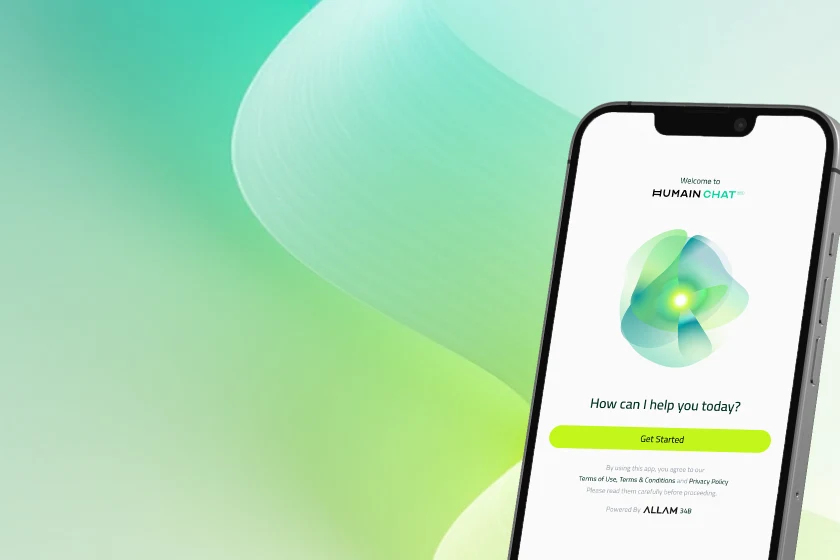
Artificial intelligence is reshaping how we communicate, learn, and work. But for Arabic speakers, the story has often been one of limitations. Many global platforms are designed first in English and only later adapted for other languages, leaving gaps in understanding and cultural context. Now, a new player from Saudi Arabia is stepping forward to change this picture.
The arrival of Humain Chat, built as an Arabic-first AI, has opened the question: could this be the true ChatGPT alternative for Arabic users? And more importantly, what does it mean for the future of AI in the region? Let’s explore a side-by-side comparison of Humain Chat vs ChatGPT.
What is Humain Chat
Humain Chat is Saudi Arabia’s homegrown conversational AI, launched in August 2025. It runs on the ALLAM 34B large language model, trained on one of the largest Arabic datasets ever assembled. The chatbot understands both Modern Standard Arabic and regional dialects, from Najdi and Hijazi to Egyptian and Levantine, while also switching smoothly between Arabic and English.
Key features include:
- Real-time web search in Arabic and English
- Strong voice recognition across dialects
- Cultural and religious sensitivity built into its responses
- Hosting on Saudi sovereign infrastructure, with full compliance to local data protection laws
Humain Chat is available as a web app and mobile app, with plans for global rollout. More than just a tool, it represents Saudi Arabia’s ambition to lead in Arabic-first AI development.
Why ChatGPT Struggles with Arabic
ChatGPT is powerful, but its strength lies in English. Studies show it performs at around 71% accuracy in English but only 42% in Arabic. The reasons are deep-rooted.
- Complexity of Arabic: A single root can generate hundreds of variations, and ChatGPT often misinterprets these.
- Dialects: Arabic isn’t one language in practice but many. Gulf Arabic, Egyptian, and Levantine all have unique vocabularies and structures that ChatGPT struggles to follow.
- Formatting issues: From misplaced punctuation to right-to-left alignment, ChatGPT often mishandles Arabic text.
- Cultural gaps: Trained mostly on Western data, ChatGPT sometimes misses the nuances of Islamic values or Middle Eastern heritage.
For Arabic speakers, this means broken conversations, mistranslations, and responses that feel distant.
How Humain Chat Fills the Gap
Humain Chat was built to put Arabic first, not second. Its training set is massive, with over 8 petabytes of Arabic data. More importantly, it was designed with cultural depth in mind.
- Dialect mastery: It recognizes and responds naturally in at least 15 dialects.
- Code-switching ease: Users can move between Arabic and English without confusion.
- Cultural intelligence: Its responses are sensitive to religious context and regional norms.
- Trust and privacy: All data stays within Saudi Arabia, giving users peace of mind.
This makes Humain Chat feel more like a conversation with someone who understands the language and culture rather than just translating.
Humain Chat vs ChatGPT Key Features
| Feature | Humain Chat | ChatGPT Arabic |
| Language Core | Arabic-first | English-first |
| Dialects | 15+ supported | Limited |
| Cultural Alignment | Islamic and regional context | Western bias |
| Data Hosting | Sovereign in Saudi Arabia | Global servers |
| Voice Input | Advanced Arabic recognition | Weak dialect handling |
| Web Search | Integrated Arabic sources | English-dominant |
For Arabic users, this means fewer mistranslations and more natural conversations.
Humain Chat and Saudi Arabia’s Vision 2030
Humain Chat isn’t just an app. It fits into the Kingdom’s larger Vision 2030 goals to make Saudi Arabia a leader in AI. By building Arabic-first AI, the country is reducing dependency on foreign systems, creating jobs, and investing in a digital economy that values its culture.
Saudi Arabia’s Public Investment Fund (PIF) has already pledged billions toward AI projects, and Humain Chat is a showcase of what homegrown talent can achieve. It brings pride, digital sovereignty, and practical value to a region of over 400 million Arabic speakers who have long needed a tailored solution.
Can Humain Chat Become the Arabic ChatGPT
If you’re asking if Humain is better in Humain Chat vs ChatGPT, the short answer is yes—at least for the Arabic-speaking world. Humain Chat already outperforms ChatGPT in dialect handling, cultural understanding, and privacy compliance. For government use, education, tourism, and daily conversations, it is a natural fit.
But challenges remain. ChatGPT has brand power, global reach, and a vast ecosystem of integrations. For Humain Chat to grow beyond the region, it will need to expand internationally and build developer-friendly tools.
Still, in the Middle East, it feels less like a competition and more like a changing tide. For the first time, Arabic speakers have an AI that truly understands them. The future of Arabic-first AI may well begin with Humain Chat.
If you are currently in Saudi Arabia, give Humain Chat a try at https://chat.humain.ai/.
FAQs
Is Humain Chat better than ChatGPT for Arabic?
Yes. Humain Chat outperforms ChatGPT in Arabic fluency, dialect recognition, and cultural sensitivity.
Does ChatGPT support Arabic?
ChatGPT supports Arabic but with lower accuracy and struggles with dialects and formatting.
Who owns Humain Chat?
Humain Chat is developed by Saudi Arabia’s Humain, backed by the Public Investment Fund (PIF).
Is Humain Chat free to use?
Humain Chat is currently available as a free web and mobile app in Saudi Arabia, with premium features and enterprise solutions expected in future updates.
Follow us on Instagram for daily travel inspiration and untold stories from the Kingdom. Want more? Explore more experiences and stories in our Business and Innovation category.
This article is brought to you by Soul of Saudi (a Saudi travel blog dedicated to uncovering the beauty, heart, and soul of the Kingdom).