








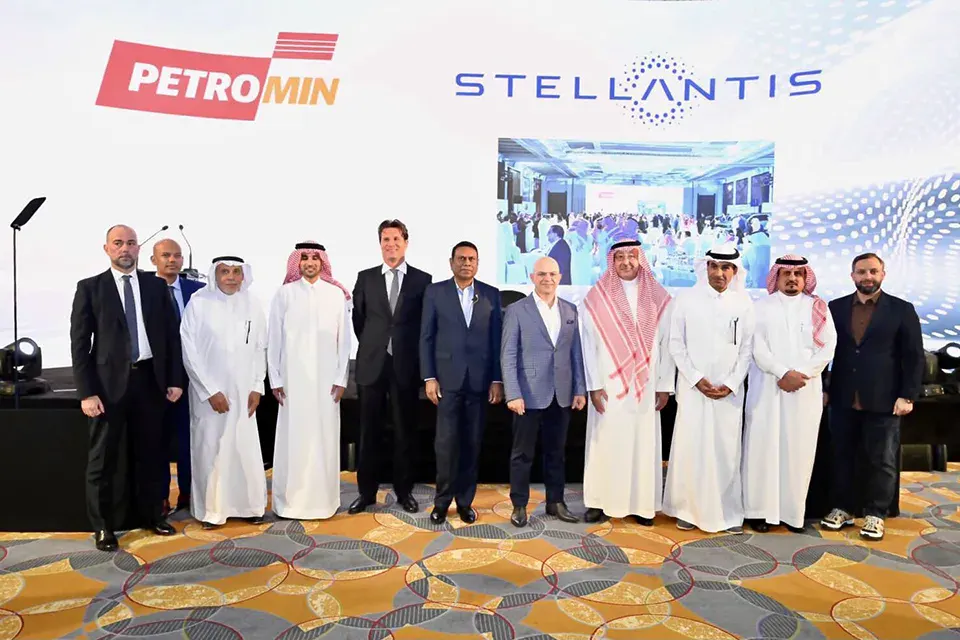
The Kingdom of Saudi Arabia is accelerating its industrial destiny. In a landmark move, the Ministry of Investment (MISA) and the National Industrial Development Center (NIDC) have signed a quadrilateral Memorandum of Understanding (MoU). The MOU is with the global automotive giant Stellantis and local energy leader Petromin Corporation.
The strategic alliance is set to explore establishing a local vehicle manufacturing plant, bringing the dream of the first Saudi-made car to reality. This isn’t just about assembling parts; it’s about building a self-sufficient automotive ecosystem on Saudi soil.
A Strategic Alliance for a New Era
This collaboration, announced on the sidelines of the U.S.-Saudi Investment Forum in Washington, D.C., signals a serious shift. The partnership brings together the perfect mix of expertise: government vision, global manufacturing prowess, and deep local market knowledge.
Stellantis, the powerhouse behind iconic brands like Jeep, Dodge, and Chrysler, brings decades of engineering excellence and a massive portfolio of American and European technology. Petromin, a long-standing champion of Saudi mobility solutions, provides the critical local infrastructure and market reach. Together with MISA and NIDC, they are evaluating the feasibility of a plant that will produce both commercial and passenger vehicles.
The project aims to act as a catalyst for the first Saudi-made car manufacturing hub, potentially reshaping the entire Middle East and Africa (MEA) automotive sector.
Vision 2030: The Engine Behind the Ambition
This initiative is a direct translation of Saudi Vision 2030 into steel and innovation. The Kingdom is no longer content with being a consumer; it is becoming a creator. The goal is clear: to evolve into a regional hub for advanced manufacturing and innovation.
By localizing vehicle production, Saudi Arabia is diversifying its economy away from oil and creating a robust industrial base. The NIDC is aggressively pursuing supplier clustering to ensure that this plant isn’t an island but the center of a thriving automotive ecosystem. The move aligns perfectly with broader national strategies to boost non-oil exports.
Just as the Riyadh-Damascus rail link aims to connect regions, this automotive project connects Saudi industrial capability with global standards.
Jobs, Tech, and Pride
The impact of this MoU goes far beyond the factory floor. A local manufacturing plant means the transfer of cutting-edge technology and know-how to Saudi engineers and technicians. It promises to create a ripple effect of employment, from the assembly line to logistics and component manufacturing.
For the Saudi consumer, it means vehicles built for local conditions with the stamp of global quality. It brings the first Saudi-made car from concept to driveway. This project reinforces the Kingdom’s position as a future-ready industrial power, attracting further international investment into the sector. It is a major step in a journey that also includes the recent JAEECO Riyadh launch, showcasing the growing appetite for diverse automotive options.
Stellantis & Petromin – A Proven Partnership
This isn’t a cold start for these partners. Stellantis and Petromin have already established a strong working relationship, having signed a Business Cooperation Agreement earlier. Petromin has successfully distributed eight Stellantis brands across the Kingdom since 2021.
Their shared history reduces risk and accelerates execution. Stellantis is committed to deep localization and regional self-sufficiency, ensuring that the vehicles produced are not just assembled in Saudi Arabia but truly integrated into the regional supply chain. This commitment mirrors the excitement surrounding other global giants entering the market, such as the Tesla showroom in Saudi Arabia.
The Road Ahead: From MoU to Production
While financial details haven’t been disclosed, the intent is unmistakable. The partners are now moving into the feasibility assessment phase. Success will hinge on building a dense supplier network and ensuring the new plant can serve not just Saudi Arabia, but the wider GCC and Levant markets.
If this project gets the green light, it will anchor a new automotive cluster, accelerating the Kingdom’s shift from oil rents to industrial rents.
It is the dawn of a new industrial age where the first Saudi-made car becomes a symbol of national pride and economic resilience. As the Kingdom prepares for electric mobility, as seen with Tesla’s launch in Saudi Arabia, this new plant could also play a pivotal role in the EV transition.
FAQs
What is the main goal of the MoU signed between Saudi Arabia, Stellantis, and Petromin?
The MoU aims to assess the feasibility of establishing a local manufacturing plant in Saudi Arabia.
Which government bodies are involved in this agreement between Stellantis and Petromin?
The agreement involves the Ministry of Investment of Saudi Arabia (MISA) and the National Industrial Development Center (NIDC).
Will this project contribute to the “first Saudi-made car” initiative?
Yes, the project is a cornerstone of the strategy to localize vehicle production and increase local value-added rates.
How does this Stellantis and Petromin partnership support Vision 2030?
It supports Vision 2030 by diversifying the economy, creating jobs, and transferring technology
What types of vehicles are expected to be manufactured through the Stellantis partnership?
The feasibility study focuses on a plant capable of producing both commercial and passenger vehicles.
Follow us on Instagram for daily travel inspiration and untold stories from the Kingdom. Want more? Explore more experiences and stories in our Business and Innovation category.
This article is brought to you by Soul of Saudi (a Saudi travel blog dedicated to uncovering the beauty, heart, and soul of the Kingdom).